


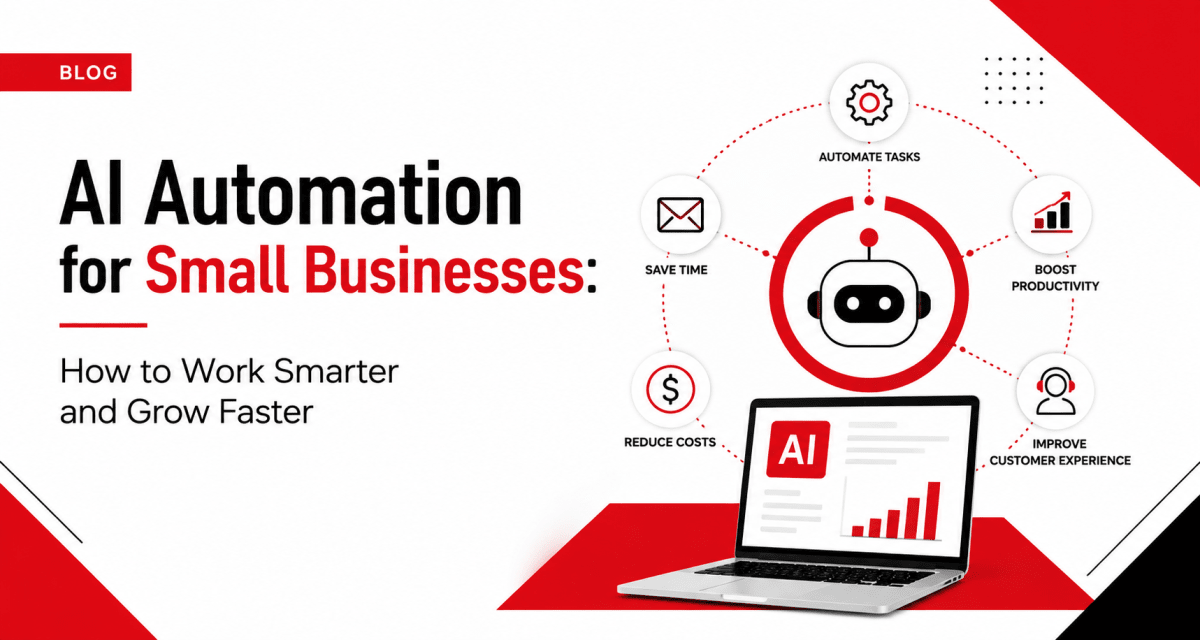
Artificial intelligence is no longer a technology reserved for companies with big budgets and dedicated tech teams. Today, small businesses can also use AI to simplify everyday work, save valuable time, improve customer experiences, and create more room for growth.
Running a small business often means wearing many hats. A small team may be responsible for marketing, customer support, sales, social media, emails, follow-ups, data entry, and administrative work, all at the same time. When most of these tasks are handled manually, they can quickly become overwhelming. They also leave more room for delays and human errors.
This is where AI automation for small businesses can make a real difference.
AI automation brings together artificial intelligence and automated workflows to handle repetitive tasks with less manual effort. Instead of spending hours every week on routine activities, businesses can allow AI-powered systems to take care of many of these processes automatically.
What Is AI Automation for Small Businesses?
AI automation is the use of AI-powered software to handle tasks that would normally require human involvement.
Traditional automation generally works according to a fixed set of rules. For example, an automated system might send an email whenever someone submits a form on a website.
AI automation takes things a step further. AI can understand information, recognize patterns, generate content, answer questions, organize data, and assist with certain business decisions.
For a small business, this could mean using AI to:
- Respond to common customer questions
- Generate marketing content
- Qualify leads
- Schedule appointments
- Send follow-up messages
- Organize customer information
- Analyze business data
- Create reports
- Automate email marketing
- Manage social media workflows
The purpose is not simply to replace people. Instead, AI automation can take work off their hands so employees can spend more time on creativity, strategy, customer relationships, and other work that needs a human touch.
Why Small Businesses Need AI Automation
Small businesses often operate with limited staff, time, and resources. Because of this, working efficiently is extremely important.
A large company might have separate teams for sales, marketing, customer service, and operations. In a small business, one person may be responsible for several of these areas.
AI automation can help reduce some of that workload and make everyday operations more manageable.
1. Save Time
One of the clearest advantages of AI automation is the amount of time it can save.
Think about tasks such as answering the same customer questions repeatedly, organizing leads, sending reminders, or preparing basic reports. Individually, these tasks may not seem like a big deal. But when they are repeated every day or every week, they can take up a significant amount of working time.
AI-powered workflows can handle many of these repetitive activities automatically.
That gives business owners and employees more time to focus on customers, business development, strategy, and other activities that directly contribute to growth.
2. Reduce Repetitive Work
Doing the same task over and over can quickly become tiring. It can also take employees away from work where their skills are more valuable.
For example, manually entering customer details into multiple systems or sending similar follow-up emails every day does not always require someone to handle each step manually.
AI automation can manage these processes using predefined workflows and instructions.
This allows employees to spend less time on repetitive work and more time on tasks that require creativity, communication, and decision-making.
3. Improve Customer Response Time
Customers today expect responses. If someone sends a question through a website, social media, or a messaging platform and has to wait for several hours, it can affect their overall experience with the business.
AI chatbots and automated communication systems can provide immediate answers to common questions.
For example, an AI-powered system can help customers find information about:
- Products or services
- Pricing
- Business hours
- Appointment availability
- Order information
- Frequently asked questions
When a question is more complicated, the conversation can be handed over to a human team member.
This creates a balance between automated support and personal customer service.
4. Support Lead Generation
For many small businesses, generating and managing leads is a major part of growth.
AI automation can help collect and organize leads from websites, advertisements, landing pages, social media, and other sources.
For example, when someone fills out a contact form, an automated workflow can:
- Capture the leads information
- Add the information to a CRM
- Identify the customers requirements
- Send a response
- Notify the sales team
- Schedule a follow-up
A process like this can make lead management much smoother and reduce the chances of potential customers being forgotten.
How AI Automation Can Help Different Areas of a Small Business
AI automation is not limited to one part of a business. It can support areas from marketing and sales to customer service and administration.
Marketing
Marketing teams can use AI automation to make content and campaign-related work more efficient.
AI can assist with:
- Blog topic research
- Content ideas
- Social media captions
- Email campaigns
- Ad copy variations
- Audience segmentation
- Campaign analysis
This does not mean marketers should hand over the creative process to AI. Human creativity, brand understanding, and strategy still matter.
Instead, AI can take care of some of the time-consuming work, allowing marketing teams to focus on creating better campaigns and connecting with their audience.
Sales
Sales teams can use AI to organize leads and identify which prospects may need attention first.
AI automation can help analyze customer interactions, interests, and engagement to help businesses better understand potential customers.
Automated follow-ups can also ensure that leads do not simply disappear because someone forgot to send a message.
For a small sales team, having a consistent follow-up process can make a noticeable difference.
Customer Support
Customer support is another area where AI automation can be useful.
AI chatbots can answer frequently asked questions at any time, while automated systems can categorize incoming requests and send them to the right team.
This can reduce response times while allowing customer support employees to spend time handling complex or sensitive issues.
The goal is not to remove the human element from customer service. It is to make sure human employees are available for the conversations where their involvement matters most.
Administration
Administrative work can take up more time than many small businesses realize.
AI automation can assist with tasks such as:
- Data entry
- Document organization
- Meeting summaries
- Appointment reminders
- notifications
- Report generation
- Email sorting
Automating some of these activities can make day-to-day operations more organized and efficient without requiring an administrative team.
Examples of AI Automation for Small Businesses
The easiest way to understand the value of AI automation is to look at how it can be used in real business situations.
Example 1: Automated Lead Follow-Up
Imagine a potential customer visits a website and submits an inquiry.
of waiting for someone from the sales team to manually respond, the system can immediately send an acknowledgment email.
The lead can then be added to the CRM, assigned to the appropriate salesperson, and placed into a follow-up workflow based on the customers response.
This helps make sure that every inquiry receives attention.
Example 2: AI Customer Support
A customer asks a question through a website chatbot.
The AI identifies what the customer is asking and provides a relevant answer.
If the question requires more detailed assistance, the conversation can be transferred to a human representative.
This allows the business to provide quick answers without making customers feel like they have to wait for every basic query.
Example 3: Automated Content Workflow
A small business wants to stay active on media but does not have enough time to create everything manually.
AI can help generate content ideas, draft captions, organize content calendars, and create different versions of content for different platforms.
The marketing team can then review, edit, and approve the content before anything is published.
This keeps humans in control while reducing the amount of time spent on the initial content creation process.
Example 4: Automated Meeting Summaries
Meetings often generate useful information, but writing down every detail afterward can be time-consuming.
AI tools can summarize meetings, highlight important points, and create lists of action items.
Instead of spending extra time preparing notes manually, team members can quickly review the summary and focus on completing the next steps.
Is AI Automation Expensive for Small Businesses?
One common misconception is that AI automation is only practical for large businesses with large technology budgets.
That is not necessarily the case.
Today, businesses can find AI tools and automation platforms at different price points. This makes it possible for small businesses to start with simple workflows and expand their use of automation as their needs grow.
The key is not to automate everything, at once.
Instead, start with a process that takes up a noticeable amount of time and see whether automation can make it easier.
For example, if a team spends several hours every week answering the same customer questions, automating that process could provide an immediate benefit.
Once the workflow is working properly, the business can look at other processes that may benefit from automation.
How to Start With AI Automation
Getting started with AI automation doesn't have to be hard. A simple way to do it is by following steps that make the process much easier.
Step 1: Find Tasks That Happen Over and Over
Start by looking at what your team does every day.
Ask yourself:
- What tasks happen all the time?
- Which activities take a lot of time?
- Which tasks have steps that're the same each time?
- Where do employees make mistakes when doing things manually?
- Which questions do customers keep asking?
These are often the places to look for chances to use automation.
Step 2: Pick the Right Process to Automate
Just because something can be automated doesn't mean it should be.
Pick processes where automation will make a difference.
Things like following up with leads, answering customer questions, sending reminders, replying to emails, and creating reports can be places to start.
The main goal should always be to fix a business problem instead of just adding new technology to the process.
Step 3: Begin with Something
A small business does not need a complicated AI system from the beginning.
Start with one or two processes.
When they are working well, check the results, find any issues, and make improvements.
After that, the business can slowly add automation to parts of the work.
Step 4: Always Have a Human Checking In
AI can be very helpful. It is not perfect.
Automated tasks should be checked regularly to make sure the information given is correct, useful, and right.
Human checking becomes very important when AI deals with customer messages, private data, or choices that could affect the business or its customers a lot.
Common Mistakes to Avoid
AI automation can offer benefits, but businesses should still think carefully before using it.
Automating for No Real Reason
Using AI just because it is popular does not automatically help the business.
Every automation needs a reason.
This could be about making responses, saving time for employees, improving how leads are handled, reducing costs, or making work more productive.
Trying to Automate Everything
Not every part of a business needs automation.
Some jobs need creativity, personal talks, experience, and human thinking.
A better way is to automate the tasks that happen all the time and keep people involved where their help really matters.
Not Paying Attention to Data Safety
Before connecting an AI tool to systems, businesses should know how it uses customer and company data.
Privacy and safety should always be part of the decision when bringing in AI automation.
Not Checking How Well It Works
Automation should be treated like any investment.
Businesses should see if the automation is actually helping.
Good measures can include:
- Time saved
- How fast responses are
- How many leads turn into business
- How happy customers are
- How productive employees are
- How much money is saved
These numbers can help a business see what is working and what needs to change.
The Future of AI Automation for Small Businesses
AI is becoming more a part of the digital business world.
As AI tools become easier to use and more available, small businesses will have chances to automate tasks that used to take a lot of time, money, or technical skills.
The businesses that get the most help will not be the ones using the most AI.
They will be the ones using it carefully.
The real benefit of AI automation is in finding a business problem and then finding the right technology to fix it.
For businesses, this can give a real advantage. A small team that can act faster, manage leads better, cut down on time-consuming tasks, and spend time on growth can compete better in a busy market.
Final Thoughts
AI automation for businesses is not just about using the latest technology. It is about finding more efficient ways to work.
From marketing and sales to customer service and admin, AI can help cut down on time-consuming work, make things more efficient, and let teams focus on what matters.
Small businesses don't need to change everything all at. Starting with one time-consuming task can be enough to see what automation can do for the business.
At Shout OTB, we believe technology works best when it is part of a business plan. The best AI automation approach can help businesses save time, improve customer interactions, make daily work smoother, and open up chances for growth that lasts.
The future of business is not about working harder. It is, about working and using the right tools to make that happen.
